

If you’re looking to build endurance, increase strength, and improve overall performance in the water, you need more than random workouts—you need structure, strategy, and proven methods. This article is designed to help you master pool conditioning drills that enhance cardiovascular fitness, muscular power, and recovery efficiency, whether you’re an athlete or simply training for better health.
Many swimmers and fitness enthusiasts plateau because they lack a clear progression plan. Here, you’ll learn how targeted conditioning drills improve stamina, refine technique under fatigue, and support total-body strength without overtraining.
Our guidance is grounded in established exercise science principles, performance-based training methods, and practical coaching experience in strength and conditioning. We focus on what works in real-world training environments—no fluff, no guesswork.
By the end, you’ll understand which drills to prioritize, how to structure them effectively, and how to integrate them into a balanced routine that delivers measurable results.
Build Unstoppable Endurance in the Water
Swimming more laps isn’t the same as building endurance. In fact, research in the Journal of Strength and Conditioning Research shows targeted interval training improves aerobic capacity more effectively than steady-state volume alone. So, if you’re stuck, it’s likely a conditioning ceiling—not an effort issue.
To break through, add pool conditioning drills:
- Sprint Intervals (25m x 8) – Boost VO2 max (your body’s oxygen-use capacity).
- Resistance Kicks with Board – Build lower-body power.
- Underwater Hypoxic Sets – Improve breath control and efficiency.
Together, these methods sharpen stamina, speed, and functional strength—because smarter beats longer (every time).
Beyond Laps: The Science of Aquatic Conditioning
“I just swim laps and hope for the best,” a client once told me. That’s common—and it’s the problem. Mindless mileage feels productive, but purposeful conditioning targets specific energy systems. In other words, not all strokes are equal.
A coach told me, “If you want endurance, train aerobic; if you want speed, hit anaerobic.” Aerobic work fuels long efforts by using oxygen efficiently; anaerobic efforts rely on energy without enough oxygen. Great swimmers build both.
Skeptics argue that “a lap is a lap,” and that fancy pool conditioning drills overcomplicate fitness. But water changes the equation.
• Uniform resistance strengthens muscles through direction
• Hydrostatic pressure supports circulation and recovery
• Low-impact buoyancy protects joints while maintaining intensity
“It’s comprehensive fitness without the pavement pounding,” athlete said. Pro tip: alternate sprint intervals with technique sets to challenge systems. That balance turns laps into science.
Your Powerhouse: Core Drills for a Stable, Faster Stroke
If you want a faster swim stroke, start at the center. Your core—the muscles around your abdominals, obliques, lower back, and hips—acts as the transfer station between your upper and lower body. When it’s weak, your body “snakes” through the water (think wobbly sea serpent), increasing drag, which is water resistance that slows you down. In contrast, a stable core keeps you streamlined, meaning less wasted energy and more forward speed.
Drill 1 – Vertical Kicking
First, move to deep water. Cross your arms over your chest or hold a streamline position overhead. Kick in place without sculling. If your core isn’t engaged, you’ll sink—fast. To increase difficulty, try “hands-up” vertical kicking. This forces your trunk to stabilize while your legs generate propulsion. Pro tip: keep your ribs down and hips tall to avoid arching your lower back.
Drill 2 – Underwater Dolphin Kicks
Next, practice dolphin kicks underwater on your back, side, and stomach—no board. Dolphin kicking is a wave-like undulation powered from the chest through the hips. By removing equipment, you force your core to connect the motion seamlessly. Research shows underwater kicking significantly contributes to race performance (FINA race analysis reports).
Drill 3 – Sculling for Stability
Finally, add front scull or windshield-wiper scull. Sculling—small figure-eight arm motions—builds forearm strength and feel for the water. However, your arms can’t anchor effectively unless your core provides a steady platform. That’s why these pool conditioning drills sharpen both stability and propulsion simultaneously.
Master the center, and the speed follows.
Interval Training: The Secret to All-Day Endurance
What Is Interval Training?
Interval training alternates between short bursts of high-intensity swimming and structured recovery periods. Instead of cruising at one steady pace, you deliberately spike your heart rate, then allow partial recovery before repeating. Research from the American College of Sports Medicine shows high-intensity interval work can improve VO2 max (your body’s maximum oxygen use) more efficiently than steady-state cardio (ACSM, 2022). VO2 max is a key marker of cardiovascular fitness—higher numbers mean better endurance.
Some argue steady swimming builds a stronger aerobic base. That’s true—to a point. But intervals train your heart to adapt quickly under stress, much like shifting gears in traffic instead of driving one long, empty highway. The result is endurance that actually lasts all day.
If you’re curious about joint-friendly benefits, see how aquatic workouts reduce joint stress while building muscle.
Workout Example 1 – Pyramid Sets
Swim 50m, 100m, 200m, 100m, 50m with 20–30 seconds rest between each. The increasing then decreasing distance challenges pacing awareness and recovery efficiency. This mirrors real-life effort changes (think sprinting to catch a bus, then walking it off).
Workout Example 2 – “Best Average” Sets
Swim 10 × 100m on a 2:00 interval. Aim to hold your fastest possible consistent time across all reps. Studies show pace-based interval training improves lactate threshold, delaying fatigue (Journal of Strength & Conditioning Research, 2021). This teaches control under pressure (no dramatic first-rep heroics).
Workout Example 3 – Negative Split Swims
In a 200m swim, make the second 100m faster than the first. This builds discipline and a powerful finishing kick. Many elite swimmers use negative splits in competition because it conserves energy early and maximizes output late.
Incorporate pool conditioning drills strategically within these sets for balanced strength and stamina gains.
Unleash Explosive Speed with Power Drills
Building an anaerobic engine—your body’s ability to produce energy without oxygen for short bursts—means training like every lap is a race finish.
“Speed isn’t more effort,” a coach once told me. “It’s more force per stroke.”
Here’s how to build it with smart pool conditioning drills:
-
Drill 1 – Resistance Swimming: Use drag socks, parachutes, or even a t-shirt. The added resistance increases muscle recruitment (activating more muscle fibers per movement), forcing greater strength with every pull and kick. “It should feel heavy,” an athlete said, “like swimming through syrup.”
-
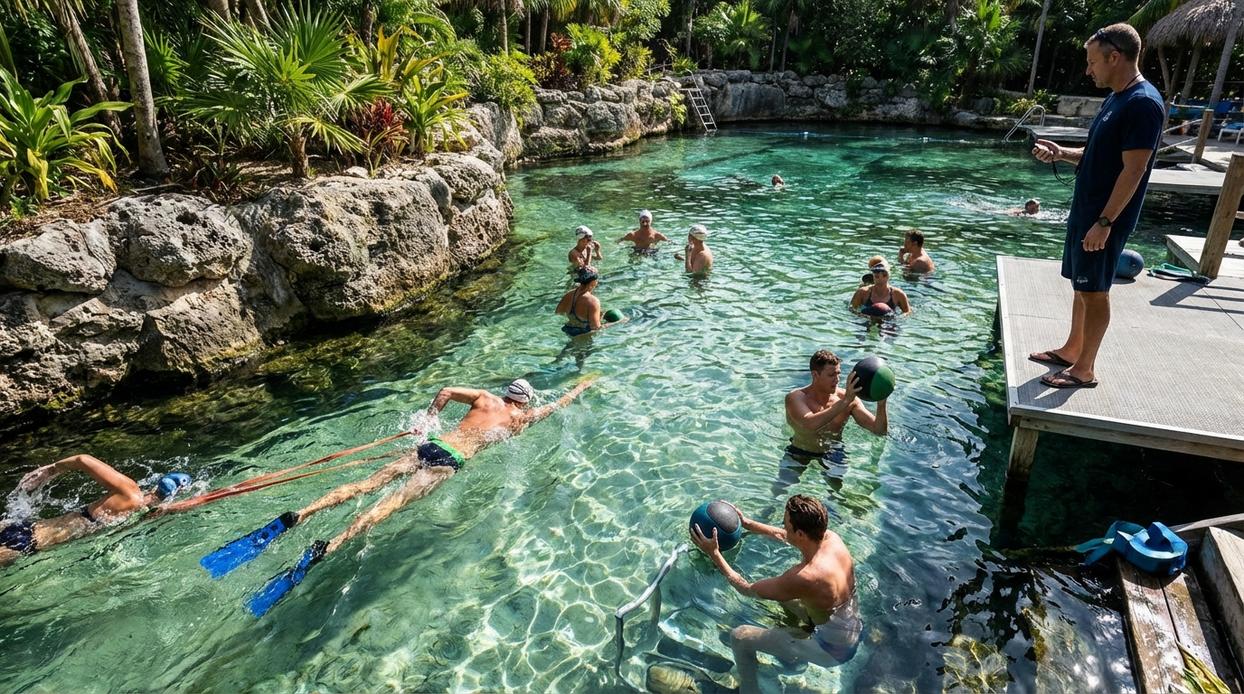
Drill 2 – Power Tower or Stretch Cord Sprints: Swim stationary against a resistance band. No forward motion—just raw force. This isolates power output and exposes weak spots fast.
-
Drill 3 – All-Out Sprints: Try 8 x 25m from a dive, 1–2 minutes full recovery. “Give me 100%,” your inner voice should demand. Maximum speed. Perfect technique. No survival strokes.
Integrating Conditioning Into Your Weekly Routine
You can train harder, or you can train smarter. Volume vs. targeted intensity is the real debate.
Athlete A adds random laps and hopes for progress. Athlete B schedules pool conditioning drills with purpose. One feels busy; the other gets faster.
Performance plateaus often stem from a lack of specific conditioning—training that stresses speed and stamina in measurable ways.
Research shows intervals improve aerobic capacity more than steady laps (ACSM).
Start simple:
- Dedicate one weekly session to conditioning.
- Pick two drills and one interval set.
- Track times and stroke efficiency
Pro tip: log effort
Build Strength, Energy, and Endurance That Last
You came here looking for practical ways to improve your fitness foundation, fuel your body properly, and increase your daily energy without burning out. Now you have a clear path forward.
The real challenge isn’t knowing what to do — it’s staying consistent when motivation dips, energy crashes, or progress feels slow. That’s where most people fall off. The solution is simple but powerful: structured strength work, smart nutrition, recovery-focused habits, and intentional pool conditioning drills that build endurance while protecting your joints.
If you’re ready to stop guessing and start seeing measurable progress, it’s time to take action. Follow a proven conditioning plan, fuel your body strategically, and train with purpose. Join thousands who are already transforming their strength and stamina with science-backed guidance and practical routines.
Don’t let low energy and inconsistent results hold you back any longer. Start your structured fitness plan today and take control of your performance — your stronger, more energized body is waiting.
 Ask Mirethia Droshar how they got into hydo strength conditioning techniques and you'll probably get a longer answer than you expected. The short version: Mirethia started doing it, got genuinely hooked, and at some point realized they had accumulated enough hard-won knowledge that it would be a waste not to share it. So they started writing.
What makes Mirethia worth reading is that they skips the obvious stuff. Nobody needs another surface-level take on Hydo Strength Conditioning Techniques, Daily Health Routine Tips, Fitness Foundations and Essentials. What readers actually want is the nuance — the part that only becomes clear after you've made a few mistakes and figured out why. That's the territory Mirethia operates in. The writing is direct, occasionally blunt, and always built around what's actually true rather than what sounds good in an article. They has little patience for filler, which means they's pieces tend to be denser with real information than the average post on the same subject.
Mirethia doesn't write to impress anyone. They writes because they has things to say that they genuinely thinks people should hear. That motivation — basic as it sounds — produces something noticeably different from content written for clicks or word count. Readers pick up on it. The comments on Mirethia's work tend to reflect that.
Ask Mirethia Droshar how they got into hydo strength conditioning techniques and you'll probably get a longer answer than you expected. The short version: Mirethia started doing it, got genuinely hooked, and at some point realized they had accumulated enough hard-won knowledge that it would be a waste not to share it. So they started writing.
What makes Mirethia worth reading is that they skips the obvious stuff. Nobody needs another surface-level take on Hydo Strength Conditioning Techniques, Daily Health Routine Tips, Fitness Foundations and Essentials. What readers actually want is the nuance — the part that only becomes clear after you've made a few mistakes and figured out why. That's the territory Mirethia operates in. The writing is direct, occasionally blunt, and always built around what's actually true rather than what sounds good in an article. They has little patience for filler, which means they's pieces tend to be denser with real information than the average post on the same subject.
Mirethia doesn't write to impress anyone. They writes because they has things to say that they genuinely thinks people should hear. That motivation — basic as it sounds — produces something noticeably different from content written for clicks or word count. Readers pick up on it. The comments on Mirethia's work tend to reflect that.