If you’re searching for a powerful, low-impact way to build strength, boost endurance, and protect your joints at the same time, aqua plyometrics exercises may be exactly what you need. This article is designed to help you understand how water-based explosive training works, why it’s so effective, and how to incorporate it safely into your routine for real performance gains.
Many people struggle to improve power and agility without aggravating knees, hips, or ankles. Training in water changes the equation. The natural resistance increases muscle engagement, while buoyancy reduces joint stress—allowing you to train explosively with less risk.
This guide draws on established principles of strength conditioning, sports science research on plyometrics, and proven recovery strategies to ensure you’re getting practical, results-driven advice. By the end, you’ll know how to structure aqua plyometrics exercises for fat loss, athletic performance, or overall conditioning—without unnecessary strain or guesswork.
Traditional plyometrics build power fast, but your knees often pay the price.
Aquatic training flips the script.
On land, force slams through joints; in water, buoyancy reduces impact while resistance challenges muscle.
Land jumps vs. pool jumps:
• Hard surfaces amplify stress and soreness.
• Water cushions landings and supports recovery.
That’s why aqua plyometrics exercises develop explosive speed without the pounding.
Start with tuck jumps and lateral bounds, then progress to split squat jumps in chest-deep water.
Skeptics argue reduced gravity limits gains, yet studies show water-based resistance maintains power output while lowering injury risk.
Train smarter, not harder.
Why Water is the Ultimate Plyometrics Playground
At first glance, explosive jump training in a pool sounds like a compromise. After all, traditionalists argue that “real” power is built against gravity on solid ground. However, that assumption ignores what water uniquely offers.
Benefit 1: Buoyancy and Impact Reduction. Water can offset up to 90% of body weight (National Library of Medicine), meaning you can jump at near‑max effort while dramatically lowering joint stress. In other words, your knees and ankles get a break without your nervous system clocking out. For athletes managing tendon pain, that’s not a downgrade—it’s a competitive edge.
Benefit 2: 360-Degree Resistance. Unlike air, water resists movement in every direction. As a result, you build concentric (lifting) and eccentric (braking) strength simultaneously—something land drills rarely match.
Benefit 3: Hydrostatic Pressure for Faster Recovery. Meanwhile, constant water pressure improves circulation and reduces swelling, similar to compression therapy (American Council on Exercise). Think of aqua plyometrics exercises as training and recovery in one session—like a superhero origin story, minus the radioactive spider.
Setting the Stage: Your Pre-Dive Safety Checklist
Before starting aqua plyometrics exercises, it helps to clarify what “safe depth” really means. Chest-deep water is ideal because buoyancy (the upward force water places on your body) reduces joint stress, while still allowing enough body weight for strength gains. In other words, you get support without losing resistance.
Next, warm up properly. Cold muscles are less elastic, which increases injury risk (think of a stiff rubber band snapping). Spend 5–10 minutes jogging in place, performing high knees, and making controlled arm circles. This gradual buildup improves circulation and mobility.
Footwear is optional but helpful. Non-slip water shoes improve traction, meaning better stability and more controlled takeoffs.
Finally, focus on form over height. Explosive doesn’t mean reckless. Prioritize alignment and soft landings before intensity. For additional guidance, explore rehabilitation exercises in water for injury prevention.
Foundational Water Jumps: Building Your Plyometric Base
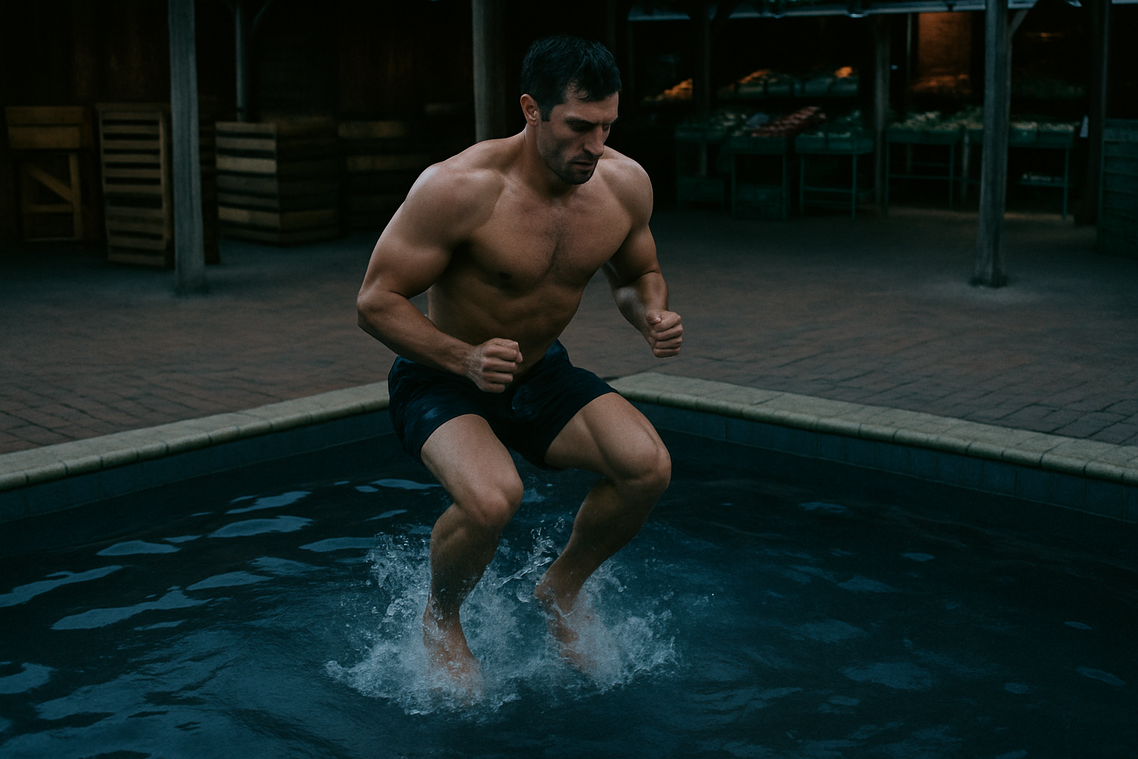
If you think jumping in water is “easier” than on land, you’re half right—and that’s exactly why it works.
Plyometrics refers to explosive movements that train muscles to produce maximum force in minimal time. Traditionally done on solid ground, they can place significant stress on joints. Research published in the Journal of Strength and Conditioning Research shows aquatic training can reduce joint impact forces by up to 50% compared to land-based equivalents while still improving power output. That’s a trade most knees are happy to make.
These foundational drills build strength, coordination, and elastic power—the ability of muscles and tendons to store and release energy (think of them like biological rubber bands).
- Aqua Squat Jumps: Stand with feet shoulder-width apart in chest-deep water. Lower into a squat and immediately explode upwards, extending your arms for height. Land softly, absorbing the impact by immediately going into your next squat.
- Water Tuck Jumps: From a standing position, jump vertically as high as possible, pulling your knees towards your chest at the peak of the jump. Extend your legs to land softly. The water’s resistance will make the “tuck” phase a core challenge.
- Split-Squat Jumps: Begin in a lunge position. Explode upwards, switching your leg position mid-air. Land softly in the opposite lunge position. This is excellent for developing single-leg power and stability.
- Pool-Edge Box Jumps: Stand facing the side of the pool in waist-to-chest deep water. Perform a squat jump, exploding up and forward to land softly with both feet on the pool deck. Step back down carefully and repeat.
Skeptics argue water dampens intensity too much to build real explosiveness. However, a 2020 study in Sports Biomechanics found comparable vertical jump improvements after six weeks of aquatic versus land training when volume was matched.
In other words, aqua plyometrics exercises aren’t a downgrade—they’re a strategic progression. Pro tip: move with intent; water slows you down, but effort must stay maximal (no lazy launches).
Depth Jumps: Stand on the pool edge. Step off (do not jump) into the water, landing on both feet. As soon as you make contact with the pool floor, immediately explode into a maximum-height vertical jump. This trains your reactive strength, meaning your ability to absorb force and redirect it quickly. Because water provides uniform resistance, your joints experience less impact stress, yet your muscles must fire faster to overcome drag. In other words, you get power without punishment.
Bounding for Distance: In waist-deep water, perform continuous, single-leg horizontal jumps, covering as much distance as possible with each bound. Focus on driving your knee up and forward, using your arms to propel you. This is a fantastic drill for improving stride power, hip stability, and coordination. Moreover, alternating legs challenges balance, forcing your core to stabilize against turbulence.
Together, these aqua plyometrics exercises build explosive capacity while protecting connective tissue. Think of it like superhero training in slow motion—controlled, but powerful. Pro tip: keep rest intervals short, around 20–30 seconds, to maintain neuromuscular responsiveness without sacrificing technique. Over time, expect sharper acceleration, higher vertical lift, and more resilient lower-body performance on land. Consistency turns water work into wins faster.
Step into the pool and feel the cool water wrap around your legs, soft yet resistant. You now have a complete toolkit of aquatic exercises that deliver the power of plyometrics without the punishment. Instead of joints pounding against hard floors, you hear gentle splashes and steady breathing. By leveraging the unique properties of water, you can train more frequently and with higher intensity while easing soreness. Start small. Incorporate one or two foundational aqua plyometrics exercises twice a week. Focus on crisp form, then gradually progress to advanced drills and unlock your full athletic potential. Feel lighter, move stronger.
Build Power, Protect Your Body, and Move With Confidence
You came here looking for a smarter way to build explosive strength without wrecking your joints. Now you know how aqua plyometrics exercises combine resistance, buoyancy, and low-impact movement to help you increase power, improve endurance, and reduce injury risk—all at the same time.
If you’ve been frustrated by nagging joint pain, stalled progress, or workouts that feel harder on your body than they should, this is your turning point. Training shouldn’t set you back. It should move you forward.
The next step is simple: start integrating aqua plyometrics exercises into your weekly routine and track how your strength, recovery, and energy improve. Don’t just read about it—experience the difference firsthand.
Join thousands who are upgrading their performance with smarter, joint-friendly training strategies. Start today, stay consistent, and feel the power of training that works with your body—not against it.