

If you’re searching for smarter ways to build strength, improve endurance, and boost daily energy, you’re in the right place. This article is designed to give you practical, science-backed strategies you can apply immediately—whether you’re refining your nutrition, upgrading your workouts, or optimizing recovery. We focus on the fundamentals that drive real progress: structured programming, sustainable fueling habits, and performance-focused routines that actually fit into your life.
You’ll learn how to structure high performance training cycles, align your nutrition with your goals, and use simple energy hacks to stay consistent without burning out. Every recommendation is grounded in established exercise science, proven conditioning principles, and real-world coaching experience working with individuals at different fitness levels.
If your goal is measurable progress—not guesswork—this guide will help you train with purpose, eat with intention, and build a foundation that supports long-term strength, resilience, and peak performance.
Beyond Random Workouts: The Blueprint for Peak Performance
Ever feel stuck despite grinding in the gym? That plateau isn’t laziness—it’s physics. Random workouts yield random results. Training without structure is like throwing darts blindfolded and hoping for a bullseye.
The fix? A structured, periodized plan built on progressive overload (gradually increasing stress) and strategic recovery (planned rest to rebuild stronger). Elite athletes rely on high performance training cycles because intensity and volume must ebb and flow—like tides, not tidal waves.
Think of your body as a bank account:
- Deposit stress wisely
- Withdraw fatigue strategically
Follow a clear system, and progress stops being luck—and starts being inevitable.
The Science of Gains: Why Your Body Needs a Plan
Periodization is the planned variation of training volume (how much you do) and intensity (how hard you push) over time. Instead of going all-out year-round, you rotate phases—strength, hypertrophy, deload—to drive progress without frying your nervous system.
This approach is rooted in General Adaptation Syndrome (GAS), a model by Hans Selye (1936). It includes three stages: Alarm (initial stress), Resistance (adaptation), and Exhaustion (burnout). Smart programming keeps you training in the Resistance phase—where growth happens—without tipping into Exhaustion.
Here’s how to apply it:
- Train hard for 3–6 weeks.
- Reduce volume by 30–50% for one deload week.
- Prioritize sleep and protein during recovery.
That recovery window triggers supercompensation—your body rebounds stronger only if rest is planned.
Contrast that with constant high-intensity workouts (think daily max-effort bootcamps). It feels productive—but it accelerates fatigue and injury.
Pro tip: Structure high performance training cycles around progressive overload and scheduled recovery for sustainable gains.
Mapping Your Journey: The Annual Plan (Macrocycle)
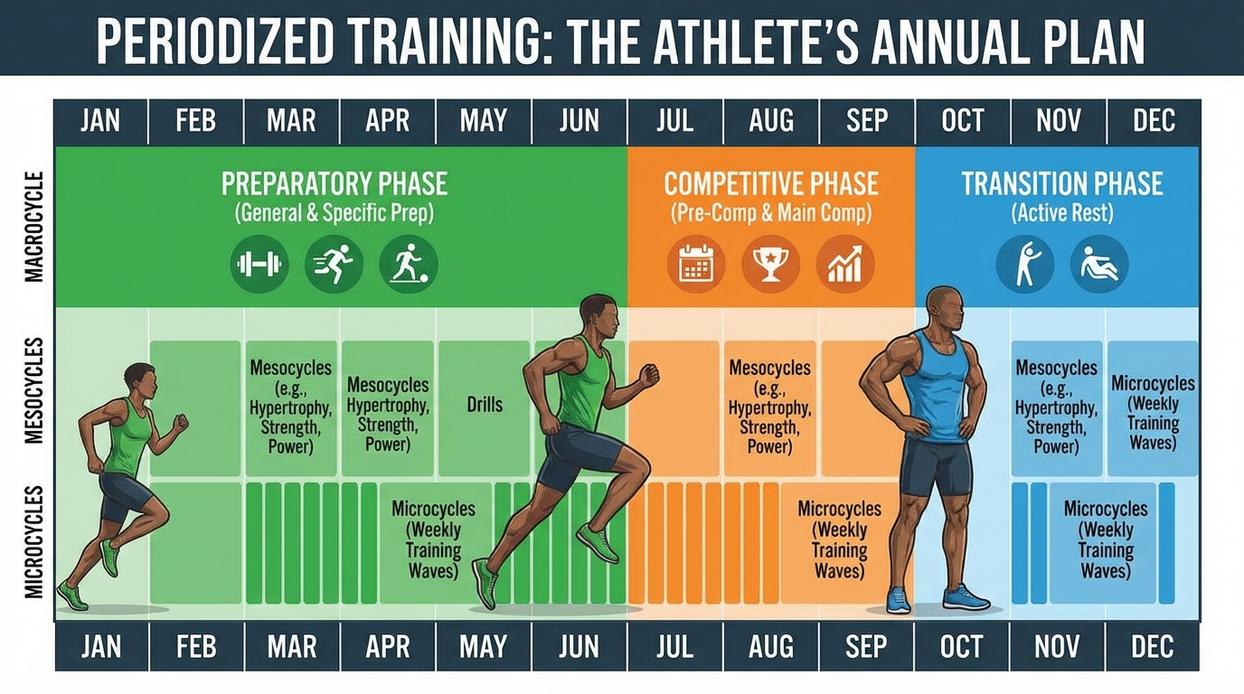
A macrocycle is your longest training phase—typically 6–12 months—built around one major performance goal, like running a marathon, stepping on a powerlifting platform, or gaining 10 pounds of muscle. Think of it as the full season arc in a sports drama: every episode (workout) builds toward the finale.
Research shows periodized training—structured long-term planning—produces greater strength and hypertrophy gains than non-periodized programs (Grgic et al., 2017, Sports Medicine). That’s why elite coaches rely on high performance training cycles instead of random workouts.
Actionable Step 1: Set a Measurable Goal
Be specific. “Build muscle” is vague. “Gain 10 lbs of lean mass in 12 months” is measurable. Use benchmarks: bodyweight, body fat %, lift numbers. Studies confirm goal specificity improves performance and adherence (Locke & Latham, 2002).
Actionable Step 2: Break It Into Phases
- Preparatory (6–8 months): Build volume, refine technique, progressive overload.
- Competitive (2–3 months): Increase intensity, reduce volume, peak performance.
- Transition (1 month): Active recovery, mobility, light cross-training.
Sample Outline: Gaining 10 lbs of Muscle
- Months 1–6: Hypertrophy focus, calorie surplus.
- Months 7–10: Strength emphasis, moderate surplus.
- Month 11: Peak lifts.
- Month 12: Deload and reset.
For mindset optimization, explore sports psychology techniques used by top athletes.
The Building Blocks: Structuring Your Monthly Phases (Mesocycles)
If long-term training plans feel confusing, let’s simplify them. A mesocycle is a focused training block that usually lasts 3–6 weeks. Think of it as one chapter inside a bigger book (the macrocycle). Each mesocycle has a clear purpose and builds toward a larger performance goal.
First comes the Accumulation Phase. This phase emphasizes volume, which means more total work—more sets, more reps, and moderate loads. The goal is to build muscle, improve endurance, and increase work capacity (your ability to handle training without burning out). For example, instead of lifting heavy for 3 reps, you might perform 4 sets of 10. Some argue high volume is “junk reps,” but research shows hypertrophy responds strongly to sufficient volume when recovery is managed (Schoenfeld, 2016).
Next is the Intensification Phase. Here, volume decreases while intensity—the weight lifted relative to your max—increases. You shift toward heavier loads and fewer reps to develop strength and power. It’s common in high performance training cycles because it teaches your nervous system to produce more force efficiently.
Finally, the Realization or Peaking Phase reduces volume further while maintaining high intensity. The aim is readiness. You’re not building anymore—you’re expressing the strength you’ve developed (like tapering before a marathon).
At the end of a mesocycle, many athletes use a deload week—a planned reduction in volume or intensity. While some believe pushing nonstop builds toughness, strategic recovery enhances supercompensation, where the body rebounds stronger than before (Issurin, 2010). In short, progress thrives on structure, not randomness.
The Daily Action Plan: Designing Your Training Week (Microcycle)
A microcycle is the shortest structured training block—typically one week—where your actual daily workouts live. Think of it as the tactical layer of your larger plan. If your mesocycle (a multi-week phase with a specific focus) emphasizes hypertrophy, your microcycle should reflect higher volume and moderate intensity. If the goal is maximal strength, weekly intensity rises while volume tapers.
Many programs stop at listing exercises. What’s often missed—and where high performance training cycles stand apart—is intentional weekly sequencing. The order of stress and recovery across seven days determines adaptation, not just the exercises themselves.
Structuring Your Weekly Split
- Upper/Lower Split: Four days alternating upper and lower body. Ideal for intermediate lifters building strength while maintaining recovery.
- Push/Pull/Legs: Separates movement patterns (pressing, pulling, lower body). Effective for hypertrophy due to focused volume per muscle group.
- Full Body Training: Three nonconsecutive days hitting all major muscle groups. Efficient and beginner-friendly (and surprisingly effective when time is tight).
Some argue rigid splits are unnecessary and that intuitive training works fine. There’s truth there—autoregulation matters. But without structure, fatigue can quietly accumulate and stall progress.
Schedule rest days as non-negotiable. Recovery drives adaptation (not the other way around). Pro tip: place rest after your most neurologically demanding session to protect performance later in the week.
You now have the full framework—from annual vision down to weekly workouts—to drive consistent results. Plateaus aren’t fate; they’re feedback that your training lacks structure. When you apply high performance training cycles, you align volume, intensity, and recovery with the body’s proven stress–adaptation response (Selye, 1956). That science matters: planned overload builds strength, scheduled deloads restore energy, and measurable metrics keep motivation high. Could your last plateau simply reflect random programming? Map a 12‑week macrocycle, define one performance goal, and outline your first four‑week mesocycle today. Start now and stay consistent. Fifteen focused minutes now can reshape months of progress.
Take Control of Your Strength, Energy, and Results
You came here looking for a smarter way to train, fuel your body, and sustain real progress. Now you understand how structured programming, proper nutrition, recovery, and high performance training cycles work together to eliminate plateaus and unlock consistent gains.
The frustration of stalled strength, low energy, and inconsistent results doesn’t have to continue. When your training has direction and your nutrition supports your output, progress stops being random — it becomes predictable.
The next step is simple: apply what you’ve learned with a structured plan that aligns your workouts, recovery, and fueling strategy. Don’t go back to guessing.
If you’re ready to build strength faster, increase daily energy, and train with purpose, start implementing a performance-driven routine today. Follow a proven system designed to remove confusion and accelerate results.
Your body can perform at a higher level — now it’s time to train like it.
 There is a specific skill involved in explaining something clearly — one that is completely separate from actually knowing the subject. Nicholas Moldenaivo has both. They has spent years working with daily health routine tips in a hands-on capacity, and an equal amount of time figuring out how to translate that experience into writing that people with different backgrounds can actually absorb and use.
Nicholas tends to approach complex subjects — Daily Health Routine Tips, Fitness Foundations and Essentials, Hydo Strength Conditioning Techniques being good examples — by starting with what the reader already knows, then building outward from there rather than dropping them in the deep end. It sounds like a small thing. In practice it makes a significant difference in whether someone finishes the article or abandons it halfway through. They is also good at knowing when to stop — a surprisingly underrated skill. Some writers bury useful information under so many caveats and qualifications that the point disappears. Nicholas knows where the point is and gets there without too many detours.
The practical effect of all this is that people who read Nicholas's work tend to come away actually capable of doing something with it. Not just vaguely informed — actually capable. For a writer working in daily health routine tips, that is probably the best possible outcome, and it's the standard Nicholas holds they's own work to.
There is a specific skill involved in explaining something clearly — one that is completely separate from actually knowing the subject. Nicholas Moldenaivo has both. They has spent years working with daily health routine tips in a hands-on capacity, and an equal amount of time figuring out how to translate that experience into writing that people with different backgrounds can actually absorb and use.
Nicholas tends to approach complex subjects — Daily Health Routine Tips, Fitness Foundations and Essentials, Hydo Strength Conditioning Techniques being good examples — by starting with what the reader already knows, then building outward from there rather than dropping them in the deep end. It sounds like a small thing. In practice it makes a significant difference in whether someone finishes the article or abandons it halfway through. They is also good at knowing when to stop — a surprisingly underrated skill. Some writers bury useful information under so many caveats and qualifications that the point disappears. Nicholas knows where the point is and gets there without too many detours.
The practical effect of all this is that people who read Nicholas's work tend to come away actually capable of doing something with it. Not just vaguely informed — actually capable. For a writer working in daily health routine tips, that is probably the best possible outcome, and it's the standard Nicholas holds they's own work to.