
If you’re searching for a smarter way to build strength, boost energy, and improve overall health, it starts with mastering the basics. Too many fitness plans jump straight into intense workouts and complicated diets, leaving you overwhelmed and inconsistent. This article focuses on what actually works: building a solid foundation through proper fundamental movement patterns, sustainable nutrition strategies, and practical daily habits that support long-term performance.
We break down how to move better, fuel your body efficiently, and apply simple energy hacks that make a real difference in your workouts and daily life. Every recommendation is grounded in proven strength conditioning principles and evidence-based nutrition practices, ensuring you’re not just following trends but applying strategies that deliver measurable results.
Whether you’re restarting your fitness journey or refining your routine, you’ll find clear, actionable guidance designed to help you move stronger, feel more energized, and make progress that lasts.
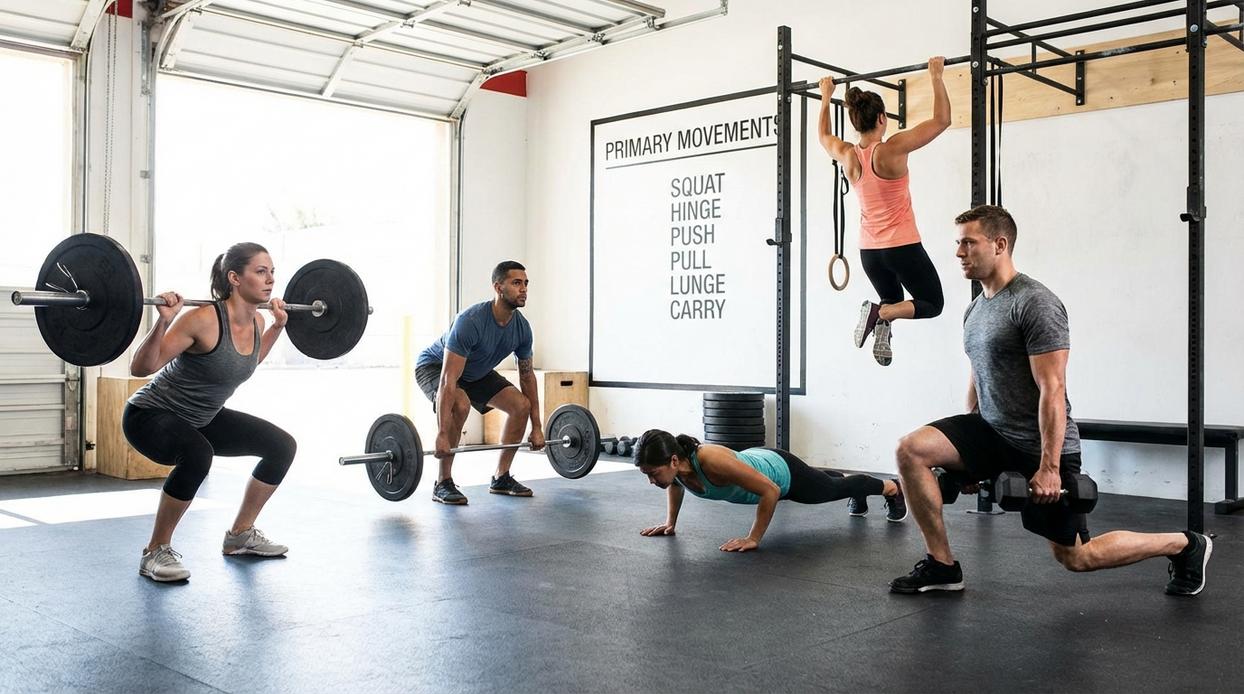
Ever wonder why your workouts stall or your back aches after a simple lift? Chances are, you’re skipping the fundamentals. This guide breaks down the seven fundamental movement patterns that shape every squat, hinge, push, pull, lunge, and carry. Instead of chasing flashy routines, we focus on precision, alignment, and control. Have you ever jumped into advanced training only to hit a plateau? Mastering these basics builds strength that transfers to daily life, from lifting groceries to climbing stairs. Moreover, sound mechanics reduce injury risk, as supported by biomechanical research (McGill, 2016). So, are you ready to move with purpose?
Why These 7 Movements Are Non-Negotiable for Health
Primal movement patterns are the foundational ways your body is designed to move. In simple terms, they are the seven basic actions that support almost everything you do. For example, when you sit down, you’re squatting; when you pick up a heavy box, you hinge; when you press a suitcase into an overhead bin, you push.
However, skip one pattern and problems creep in. Weak hinges strain your lower back; neglected pulls round your shoulders; limited rotation stiffens your spine. Over time, these imbalances lead to chronic pain and stalled progress.
So, start simple. First, test each of the fundamental movement patterns with bodyweight reps. Next, strengthen weak links using controlled sets of 8–12. Finally, integrate them into daily life—squat to chairs, hinge for groceries, carry evenly. Master these basics, and building muscle or losing fat becomes faster and safer long term.
Technique 1 & 2: The Squat and The Lunge (Lower Body Foundation)
The squat is one of the most researched lower-body exercises—and for good reason. Studies show squat variations significantly improve lower-body strength and functional performance (NSCA Journal). As one of the core fundamental movement patterns, it builds strength you use daily—like standing up from a chair (yes, that counts as training).
Step-by-step bodyweight squat cues:
- Break at the hips and knees simultaneously
- Keep your chest up
- Drive knees out as you descend
Common mistakes—and fixes:
- Knees caving in: Actively press knees outward; think “spread the floor.”
- Leaning too far forward: Lift your chest and shift weight mid-foot.
- Not going deep enough: Lower until thighs are at least parallel (research links deeper squats to greater glute activation).
Some argue squats are risky for the knees. However, evidence shows proper squat mechanics can reduce knee stress by strengthening surrounding muscles (Journal of Strength and Conditioning Research).
The lunge complements the squat by training one leg at a time (called unilateral training). Research indicates unilateral work improves balance and exposes strength imbalances.
Lunge Form Checklist:
- Both legs at 90-degree angles
- Stable front foot
- Drive up through the front heel
If you wobble, that’s feedback—not failure.
Technique 3 & 4: The Hinge and The Carry (Building a Resilient Core)
First, let’s clear this up: the hip hinge is not a squat. A squat is knee-dominant—meaning the knees bend deeply while the torso stays upright. In contrast, a hinge is hip-dominant, with minimal knee bend and the hips driving straight back. Think closing a car door with your hips. In my opinion, most back injuries in the gym happen because people blur this line (and then blame deadlifts).
To practice, grab a dowel or broomstick and place it along your spine. Keep three points of contact—head, upper back, and tailbone—while pushing your hips back. This “neutral spine” position means your back stays naturally aligned, not rounded or overarched. If the stick loses contact, you’ve cheated the movement.
Now, onto the loaded carry—specifically the farmer’s walk. I consider it the ultimate functional core exercise because your core’s main job is resisting movement, not creating it. Stand tall, shoulders back and down, brace your midsection, and take short, deliberate steps. The suitcase carry (weight on one side) adds anti-rotation demand.
Some argue machines isolate muscles better. Maybe. But fundamental movement patterns build real-world strength. For programming ideas, see how to create a beginner workout plan that sticks.
Technique 5 & 6: The Push and The Pull (Upper Body Balance)
The push-up represents the horizontal push in the five fundamental movement patterns. Done well, it builds strength, stability, and control. Done poorly, it reinforces bad habits (and cranky shoulders).
Start with hands just outside shoulder width, fingers spread. Create a straight line from head to heels, squeeze glutes, brace your core, and lower until your chest nearly touches the floor. Full range of motion matters; half-reps only teach half-strength. Press back up without letting hips sag or flare.
Push-Up Progressions
Not everyone owns a perfect floor push-up—and that’s fine.
- Wall push-ups
- Incline push-ups
- Knee push-ups
- Full push-ups
I’ll admit, there’s debate about knee push-ups. Some coaches skip them. I’ve found they help when done with strict alignment.
The horizontal pull (row) balances all that pushing—and combats our desk-bound, slouched reality. Rowing strengthens the upper back muscles that hold posture upright.
With a resistance band, begin by pulling your shoulder blades back first, then drive elbows toward your ribs. Don’t yank with your arms. Control the return. If you only feel your biceps, something’s off.
Perfect form isn’t always obvious. Film yourself if unsure. Small tweaks make big differences.
The overhead press builds shoulder strength and stability by driving weight vertically overhead. As one of the fundamental movement patterns, it trains force from feet to hands.
Key cues:
- Core tight (brace like you’re to be poked)
- Glutes squeezed
- Press in a straight line
- Finish with bicep by the ear
You now have the blueprint for the seven essential movements that govern all human strength and fitness. The frustration of ineffective workouts disappears when you return to high-quality fundamentals instead of chasing flashy programs. Many competitors obsess over volume and biohacks, but few emphasize mastering fundamental movement patterns with intention. Quality beats novelty. By consciously practicing them, you build a resilient body that resists injury and performs outside the gym.
• Slow down your reps.
• Film one set this week.
Pick the squat and refine it daily—sit, stand, repeat (yes, like Karate Kid, but stronger). Precision compounds into lifelong strength gains.
Mastering essential movement patterns not only enhances your physical performance but also sets a solid foundation for overall wellness, which you can further explore in our article, ‘Advice Tips Ontpwellness.’
Build Strength Where It Matters Most
You came here to understand how to build real strength, improve daily performance, and create a body that moves with power and efficiency. Now you know that lasting results don’t come from random workouts — they’re built on mastering fundamental movement patterns, dialing in smart nutrition, and protecting your energy every single day.
The real frustration isn’t effort — it’s putting in effort without seeing progress. When your training lacks structure or your recovery is off, results stall. That’s why focusing on movement quality, strength conditioning, and sustainable habits changes everything.
Now it’s your move. Start refining your fundamental movement patterns, fuel your body intentionally, and follow a proven strength strategy instead of guessing. If you’re ready to stop spinning your wheels and finally build strength that lasts, take action today. Join the thousands who trust our proven fitness guidance and start transforming your performance now.
 Ask Mirethia Droshar how they got into hydo strength conditioning techniques and you'll probably get a longer answer than you expected. The short version: Mirethia started doing it, got genuinely hooked, and at some point realized they had accumulated enough hard-won knowledge that it would be a waste not to share it. So they started writing.
What makes Mirethia worth reading is that they skips the obvious stuff. Nobody needs another surface-level take on Hydo Strength Conditioning Techniques, Daily Health Routine Tips, Fitness Foundations and Essentials. What readers actually want is the nuance — the part that only becomes clear after you've made a few mistakes and figured out why. That's the territory Mirethia operates in. The writing is direct, occasionally blunt, and always built around what's actually true rather than what sounds good in an article. They has little patience for filler, which means they's pieces tend to be denser with real information than the average post on the same subject.
Mirethia doesn't write to impress anyone. They writes because they has things to say that they genuinely thinks people should hear. That motivation — basic as it sounds — produces something noticeably different from content written for clicks or word count. Readers pick up on it. The comments on Mirethia's work tend to reflect that.
Ask Mirethia Droshar how they got into hydo strength conditioning techniques and you'll probably get a longer answer than you expected. The short version: Mirethia started doing it, got genuinely hooked, and at some point realized they had accumulated enough hard-won knowledge that it would be a waste not to share it. So they started writing.
What makes Mirethia worth reading is that they skips the obvious stuff. Nobody needs another surface-level take on Hydo Strength Conditioning Techniques, Daily Health Routine Tips, Fitness Foundations and Essentials. What readers actually want is the nuance — the part that only becomes clear after you've made a few mistakes and figured out why. That's the territory Mirethia operates in. The writing is direct, occasionally blunt, and always built around what's actually true rather than what sounds good in an article. They has little patience for filler, which means they's pieces tend to be denser with real information than the average post on the same subject.
Mirethia doesn't write to impress anyone. They writes because they has things to say that they genuinely thinks people should hear. That motivation — basic as it sounds — produces something noticeably different from content written for clicks or word count. Readers pick up on it. The comments on Mirethia's work tend to reflect that.